


Venezuela: a troubled nation with a troubled economy.
- Pierre
- Jun 28, 2021
- 5 min read
by Pierre-Jean
“The crisis in Venezuela is a political crisis, an economic crisis, and a humanitarian crisis. ”As said by Tulia Falleti, there is no better way to describe the current situation in the Bolivarian Republic. A once perfect display of anti-imperialism and democratic socialism in South America has become one of the biggest economic disasters of the 21st century. However, who is to blame for such this catastrophe, and how did a catastrophe of such scale even occur?
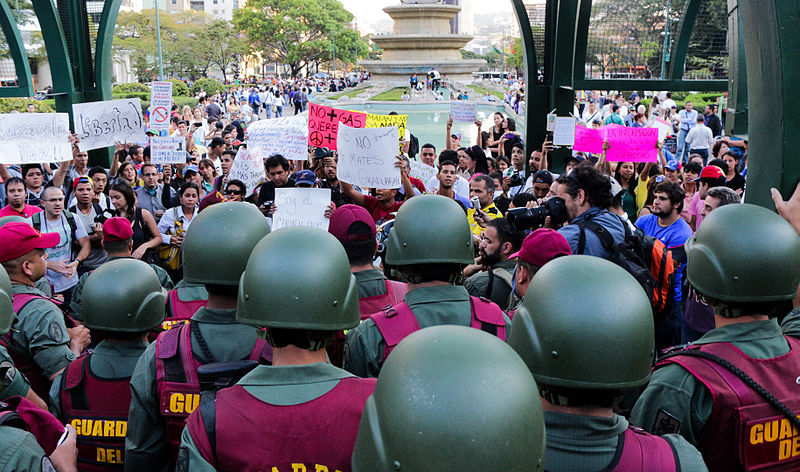
Source: Wikimedia
Venezuela has the largest proven oil reserves in the world, this has had both positive and negative effects on the economy of the south american state. While it guarantees a certain amount of geopolitical influence and high economic returns, turning the nation into a one commodity country. While in itself, the oil reserves doesn’t seem negative at first, since many countries rely on oil, if managed incorrectly, the dependency on oil could potentially tank an entire economy. An economic factor which threatens nation states who are reliant on one single resource is Dutch Disease (which is the causal relationship between the increase in the economic development of a specific sector and a decline in other sectors). In the case of Venezuela, that specific sector was petroleum exploitation and importation. This was the case during the boom of the worldwide oil industry in the early 20th century. By the late 1920s, oil dominated basically every other economic sector in the nation, undermining other sectors like agriculture, which went from being ⅓ of the economic output during the 1920s to only making up 1/10 of it in the 1950s. This has set back the nation dramatically compared to other western and industrialized nations, the effects of this "oil-centric" economy are still being felt today. Despite two decades of supposed “state socialism”, its geopolitical influence through OPEC, and its economic advantages, having an estimated 296.5 billion barrels in oil reserves, Venezuela have faced troubles in keeping a good HDI score in recent years and have now found itself nearer to the bottom than to the top, placed at 113.

Source: International Business Times
It is important to note that the events that have occurred in our present time are not so different from what happened a few decades ago, although less amplified. This is critical to understanding Venezuela’s present and future. Many believe that Venezuela's current geopolitical issue is purely a socio-political one, one of ideology and demigaughs. However, while all of this is true to some extent, we cannot forget that petroleum is at the heart of it all. This was the case for Hugo Chavez, an ex military official turned Marxist revolutionary, who would later overthrow the government in a popular "revolution" against the status quo at the time, delivering on his promises of a “socialist” utopia. In fact, his schemes weren’t so different from his predecessors, but this didn’t seem to bother his supporters, who wanted a full radical change in the government. In the late 1970s, OPEC, which was majoritarily composed of Arab nations, put in place an embargo on oil to the USA and other nations supportive of Israel. This was done in the larger context of the conflict between the Arab world and Israel, more precisely the reconquering of the Golan Heights by Egypt and the retaliation of both the USA and Israel against it. Venezuela, as a member of OPEC, saw its state coffers implode. This was caused by the increase in gas prices brought in by the embargo, which heavily benefited the major oil producers. The state used this new found wealth to fund state subsidized programs. This was initially good, until the embargo was lifted and gas prices returned to normal in the 1980s. This left the South american nation in peril as it could no longer fully rely on oil as a main source of funding for its state programs. To add to the discontent, Perez who was the president at the time was revealed in 1979 to be corrupt and have used state money for personal benefit. Despite this revelation, he was reelected in 1989 to lead a distraught and economically impoverished country. Regardless of the promises he made to bring back the nation to what it was a decade ago, he started to impose austerity measures and cut state funded projects. These measures were deeply unpopular, and motivated Hugo Chavez to take action. Chavez alongside the MBR-200, a radical revolutionary group founded within the military, attempted a coup which was called Operation Zamora against the government in 1992. In spite of the operation’s failure, Chavez became hugely popular especially among the poor. This popularity would only rise throughout the years until 1998, where he decided to run for president despite believing that the oligarchy would never let him win such an election. He won, with a landslide victory of 68%. However he would commit the same mistakes as his predecessors, using rising oil prices to fund state funded programs to help the poor. And as the saying goes, history often repeats itself.

Source: Wikimedia
Chavez proved successful at one thing, getting the lower class to support him, in terms of state subsidized programs he had helped millions of people out of poverty through improved education and welfare. However, this was once again mostly funded through oil, more precisely, PDVSA, the nationalized oil corporation. The PDVSA were not a big fan of Chavez, to the extent that they nearly attempted a coup in 2002 against the former president., when that didn't work, they striked. This all led to massive changes in PDVSA, including poor reconstruction and a massive brain drain which heavily impacted the nation's oil business. PDVSA had lost ⅓ of its workforce which led to a drastic decrease in oil output, something the nation deeply needed. This would eventually lead to a massive economic downturn, and all culminated in 2010 when Chavez declared an “economic war”, in which he started controlling the prices of basic necessities such as food, which increased shortages. This would be worsened by the death of Chavez and the rise in power of Maduro. While not being the sole person responsible for the crisis, he only worsened it by a mix of bad policy and corruption, exacerbated not only the food shortages but the economy as a whole. These policies included withholding the US dollar and other foreign currencies from entering Venezuelan territory, whilst the government printed increasingly more money, causing hyperinflation and worsening the crisis. The Venezuelan Bolivar nearly lost 99% of its value and famine became a huge problem Venezuela, with nearly half of the population starving.

Source: The New York Times
In conclusion, what caused the downfall of Venezuela was not politics or clashes of ideology, but rather a continued and struggling maintenance of an economy which relies on one resource, a resource which is essential to survival and existence of the country. Only time will tell if Venezuela will ever get back on its feet, and maybe, become once more the beacon of South America. As for who is to blame, those who play games with politics instead of solve issues are the main culprit, populists like Chavez and corrupted politicians such as Perez, who ignored the main issues of the nation and favored political goals above all else.
References:
Gustavo Coronel (1983). The Nationalization of the Venezuelan Oil Industry. Heath and Company.
US Energy Information Administration, "Country Energy Profiles: Venezuela", US Energy Information Administration,


Comments